For years, risk adjustment has operated like a rewind button, fixing documentation after the visit instead of getting it right during the encounter.
Charts are closed. Visits were done, and only then did the real work begin for coders: retrospective reviews, coding sweeps, and last minute RAF recovery efforts designed to catch what was missed.
That model is breaking. For most teams, this shift isn’t theoretical. It shows up as unstable RAF scores, growing audit pressure, and a lack of confidence in whether suspected conditions are actually defensible.
The CMS 2027 Proposed Rule makes it clear: retrospective cleanup is no longer the safety net it once was.
The Safety Net Is Dissolving
Historically, retrospecting coding has served as a safety net. Plans and providers could rely on post visit chart reviews to identify undocumented conditions, fill RAF gaps, and protect revenue.
But that safety net has steadily been breaking. Between increased scrutiny, evolving audit methodologies, and signals that RADV (Risk Adjustment Data Validation) is nearing its end state, the message from CMS is clear: If it wasn’t documented correctly at the point of care, it may not count at all. Retrospective coding didn’t just fill gaps, it created a sense of security. That security is now eroding.
Why CMS is Forcing the Shift
This isn’t arbitrary, it’s intentional. If you’ve been anywhere near Medicare Advantage lately, you’ve seen the headlines. Plans getting audited, billions in payments questioned, and ongoing debates about whether diagnoses are actually supported or accurate.
A lot of that traces back to one thing: risk being captured after the visit. Payments are based on diagnoses that don’t always clearly tie back to what actually happened in the room with the patient. As a result, CMS is pushing the industry toward a model where:
- Coding reflects real time clinical decision making, not after the fact interpretation
- Documentation is complete and accurate at the point of care
- Risk scores are supported by auditable, encounter documented evidence
In other words, Risk Adjustment is being pulled upstream, closer to the patient encounter. When you view it through that lens, retrospective coding starts to look less like a solution, and more like a workaround.
The Operational Gap No One Can Ignore
Providers are being asked to code comprehensively in real time. While navigating fragmented data, working with incomplete patient histories, and EHR workflows that weren’t built for longitudinal risk visibility.
CMS is effectively saying: “get it right during the visit.” The challenge though is that most systems today don’t make that easy.
Many organizations believe they’ve already made the shift to prospective coding. In reality, most are still relying on retrospective workflows, just earlier in the process.
This is where organizations will struggle. Because shifting to a prospective model isn’t just a policy response, it’s an operational transformation.
What Prospective Coding Actually Requires
Moving upstream requires rethinking the entire workflow, not just adding more alerts or post visit reviews.
- Pre-visit intelligence: Surface likely conditions before the encounter
- Evidence-based suspecting: Prioritize clinically supportable conditions, not just revenue opportunities
- In-visit support: Deliver insights that fit naturally into provider workflows
- Recapture discipline: Ensure previously documented conditions are reassessed and validated
Rather than delivering more alerts or noise, it’s about delivering the right information, at the right time, and with the right evidence support.
Suspecting without clinical evidence doesn’t just create noise. It creates audit risk.
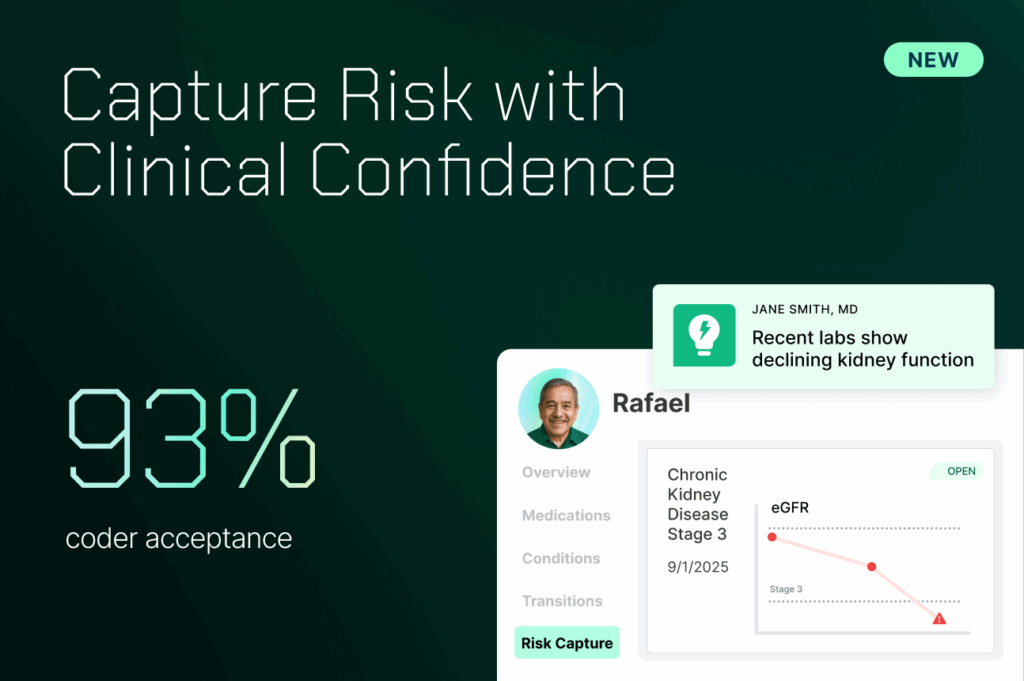
But when the right data shows up early, the entire model changes. In the work we’ve done with our customers, 77% of patients have at least one clinically supportable condition surfaced before the encounter even begins. Which means the visit isn’t where risk adjustment starts. It’s where it gets confirmed.
The question isn’t whether prospective risk adjustment is possible. It’s whether your organization is set up to act on it.
How Zus Enables the Prospective Model
Solving this isn’t about adding more alerts or another point solution. It requires infrastructure that supports real-time, evidence-based decision making across the entire workflow. That’s the gap we’re focused on filling at Zus.
Zus supports this prospective model by enabling:
- Evidence Based Suspecting that prioritizes clinical validity over volume
- Longitudinal Data Integration to give providers a complete picture of the patient
- Point-of-care Delivery that fits into existing workflows
- Recapture Support to ensure continuity and accuracy over time
A New Operating Model
The era of Retrospective first Risk Adjustment is ending.
What replaces it isn’t just a new tactic, it’s a new operating model, one where:
- Accuracy happens before or during, not after, the encounter
- Compliance is built in, not audited later
Revenue integrity is a function of clinical alignment, not coding recoveryWithout this shift, organizations will continue investing in retrospective recovery, while audit risk increases and real-time accuracy continues to lag.
Organizations that adapt will be more efficient, more compliant, and better aligned with where CMS is pushing the industry. Those that don’t will spend the next few years trying to patch a model that no longer holds.
The shift to prospective risk adjustment is already underway. Most organizations think they’re ready for this shift. Very few actually are.