
One of the highlights of our recent trip to the Sunshine State for the Florida Association of ACOs (FLAACOs) 2025 Conference was the opportunity to host a roundtable discussion with several dozen attendees. We decided to center this session on one question for those in the room:
What’s keeping you up at night?
In other words, we wanted to know which evolving demands, growing risks, or increasing pressures in the value-based care world are having the biggest impact on their practices right now. What we got was a lively conversation from which several key areas of concern emerged.
1. Changing Risk Codes
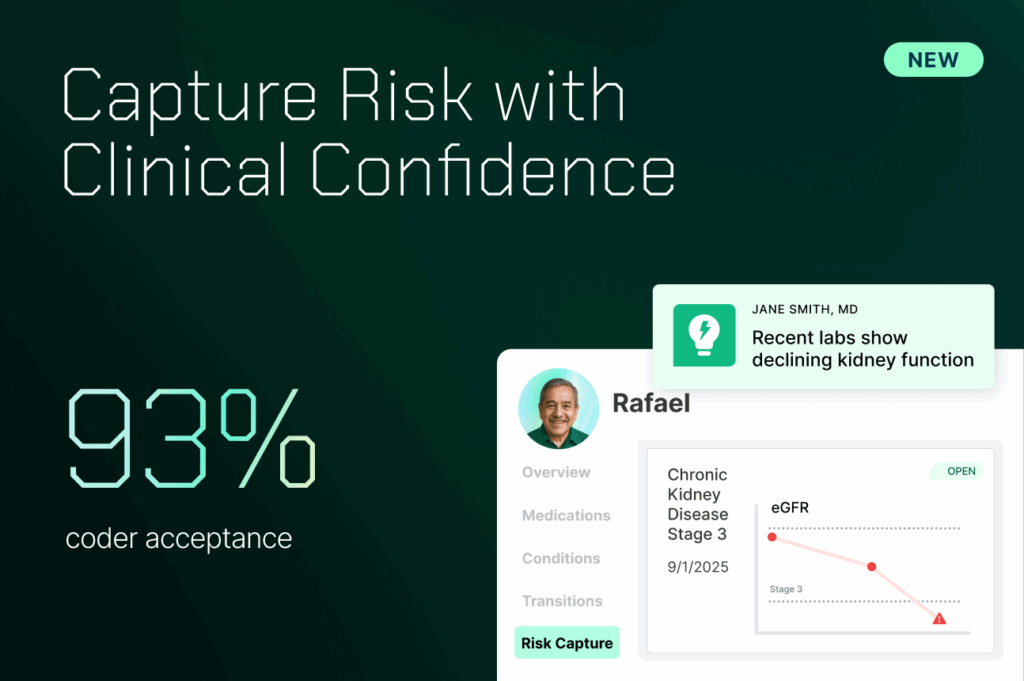
The most interesting thing here was how unconcerned everyone in the room seemed to be about the coming algorithm change from V24 to V28 for risk codes.
This is going to eliminate some of the codes between Medicare and Medicare Advantage programs that were driving diagnosis but not driving treatment. Take senile purpura – common, harmless, rarely treated. Under V28, codes like this will disappear because they inflate risk scores without shaping care.
It’s going to be a significant change for accountable care organizations (ACOs) in 2028. They’re going to see a roughly 7% to 13% reduction in their risk adjustment score, which is a big challenge. An ACO might have had a $10,000 patient that’s now a $9,700 patient – and nothing really changed other than the coefficients. They’ll basically lose ground just because of a change in the model.
But these changes aren’t just about cutting costs, they’re ultimately about delivering better patient care. There’s going to be pressure to make faster diagnoses, detect diseases earlier, and prevent complications from arising. That all sounds pretty straightforward, but many providers aren’t prepared for the change.
So even though they may not be terribly concerned right now, this is one issue that will likely be closer to the top of their list of concerns if we ask the same question next year.
2. Medication Adherence
One topic that several attendees did raise as an ongoing concern was medication adherence.
Being good at medication adherence is really about understanding when a patient is at risk, such as identifying when they’ve skipped taking their medication for two or three days. Those types of lapses allow diseases to linger, conditions to deteriorate, and complications to arise.
Of course, the primary goal of improving medication adherence is to provide better patient care. But doing so can also help medical groups maintain favorable Medicare Advantage Stars ratings. You can’t get to four or five stars if you can’t manage medication adherence.
Getting pills in the hands of patients and making sure they take them has long been a problem area for providers. But the good news is there’s an opportunity here to use technology to help.
Zus can pull prescription data to help providers more clearly see and understand when a patient might be at risk of straying from their medication regimen. For example, a provider can get a real-time alert if a patient hasn’t picked up their medication from the pharmacy on time, which is an opportunity to reach out and get that patient back on track.
The bottom line? When patients have the right meds – and take them when they’re supposed to – they tend to have better outcomes. Providers can help make that happen.
3. Patient-provider Communication and Engagement
One of the contributing factors to the medication adherence problem is a broader issue that many attendees in the room brought up – the need for better and more proactive communication with patients.
Beyond medication reminders, providers want to be able to get in touch with patients to discuss any questions they might have and to talk about ways they can improve their health. But they’re often frustrated by a lack of current contact information, especially for patients who have moved around a lot.
This is one of the benefits of common patient records. If a patient updates their phone number while visiting an out-of-network ER, their primary care provider also has access to the new contact info for follow-up.
Instead of having data from various providers scattered and siloed, all of a patient’s contact information over time is collected in one convenient place. It’s just one element of a more complete patient picture, which can allow providers to deliver timelier, more informed, and more proactive care.
One example of enhancing proactive communication that we highlighted in the roundtable discussion is Homeward Health, which uses AI to quickly get its in-home care providers up to speed with patients’ medical histories and current issues. This saves time and makes the patient more comfortable with and confident in their care team right from the start.
More readily available access to data can lead to a better understanding of the patient and better clinical context – for humans and AI – which can lead to more proactive and empathetic outreach.
4. A Middling Patient Experience
While the above three issues were among the most pressing in the roundtable, other sessions and conversations during the conference highlighted some of the other risks and challenges facing ACOs.
One that we heard mentioned time and time again was some variation of the ongoing erosion of patient trust following the pandemic. This has shown up in reduced patient experience survey scores, which continue to slide for many providers.
Think about one of the most persistent complaints about visiting the doctor – the burden on patients to share their information over and over. If a patient visits three different providers for the same issue, they have to reiterate the same details of their medical history three different times. This is not something they’re encountering in other areas of their life.
Here again, there’s an opportunity for providers to right the ship. By using data from a common patient record to proactively reach out and show patients that they have their information and understand their concerns, providers can clearly demonstrate how they’re working to deliver the best care possible.
Looking Ahead to 2026 and Beyond
While none of these risks or challenges are going to disappear anytime soon, sitting back and hoping for them to get better is not a winning strategy.
This is a great time to be practicing medicine, with medications, treatments, and clinical pathways that we’ve never had before. Now it’s just a matter of using data to translate all of that into better patient care. Patients want a better healthcare experience and providers have the ability to provide it.
In 2026, the winners will be the organizations turning fragmented data into proactive human outreach – faster than the rest of the field.